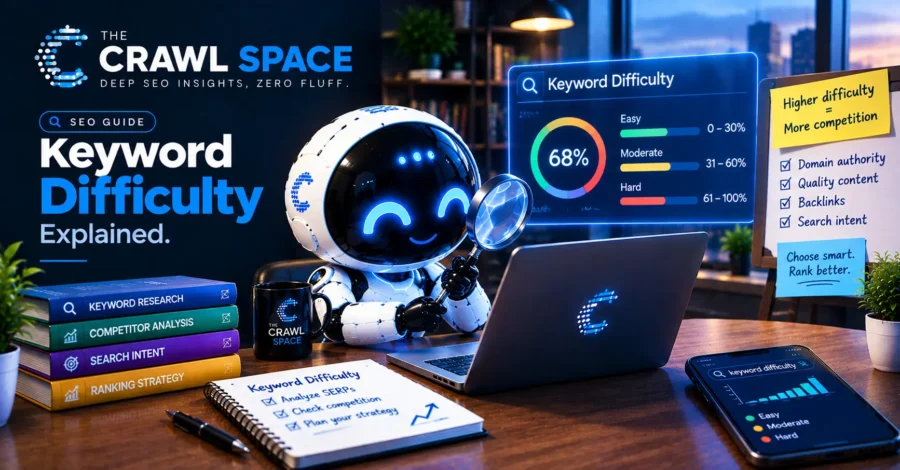
Keyword difficulty is a 0–100 score, produced by SEO tools, that estimates how hard it would be to rank on the first page for a given term — typically based on the backlink and authority profile of the pages currently ranking for it. This article is part of the What Is Keyword Research? guide.
Why the Same Keyword Gets Wildly Different Scores Across Tools
Run the identical keyword through Ahrefs, Semrush, and Moz, and it’s common to see three noticeably different difficulty scores — sometimes differing by 30 points or more, despite all three landing on the same general “hard” or “easy” verdict. This isn’t a bug or an inconsistency to be suspicious of; it’s because each tool uses its own proprietary formula built from different inputs. Ahrefs weighs difficulty heavily on the number of unique referring domains linking to the top 10 ranking pages. Semrush’s calculation is more layered, factoring in median referring domains, the ratio of dofollow to nofollow links, an internal authority score for each ranking domain, and even which SERP features appear for that query. Moz bases its score primarily on the Page Authority and Domain Authority of whatever currently sits in the top 10. Three genuinely different methodologies, measuring related but not identical things, will naturally produce three different numbers for the same search term.
Difficulty Should Be Read Relative to Your Own Site, Not as an Absolute
A raw difficulty score means little without context about the site trying to rank. Some tools address this directly — Semrush, for instance, offers a personalized difficulty score calibrated to a specific domain’s own authority, where the same keyword might show as comfortably achievable for an established site and dramatically harder for a brand-new one. Even without that specific feature, a useful general habit is treating difficulty scores as tiered against your own site’s current authority level rather than as one universal threshold everyone should aim below — what counts as a realistic target for a well-established domain is a poor target for a brand-new one, and vice versa.
What Keyword Difficulty Doesn’t Measure: Zero-Click Risk
A difficulty score reflects link and authority competition — it says nothing about whether ranking for that term will actually deliver meaningful traffic once you get there. As covered in Keyword Search Volume, a growing share of searches end without any click at all, particularly for queries where an AI Overview or other SERP feature answers the question directly. A term can carry the exact same difficulty score it did a year or two ago while delivering dramatically less real traffic today, simply because Google now answers that query on the results page itself. Difficulty and traffic potential are related but genuinely separate questions, and a low difficulty score alone doesn’t guarantee a term is still worth the effort.
What Keyword Difficulty Doesn’t Measure: Whether Your Content Is Actually Better
A difficulty score is fundamentally a proxy for the authority of pages currently ranking — it doesn’t evaluate whether a new piece of content is actually a stronger, more complete answer to the query than what’s already sitting in the top 10. A page can score as “achievable” by the numbers and still fail to displace the current results if it doesn’t genuinely serve the search better. This is part of why manually checking the current top-ranking pages — their actual depth, structure, and how well they address the query — remains necessary even after checking a difficulty score.
→ For the full manual-check habit as part of the broader process: How to Do Keyword Research
Common Mistakes
- Treating a difficulty score as an exact, universal measurement, rather than one tool’s own proprietary estimate
- Comparing scores across different tools directly, when a 45 in one tool and a 45 in another may not represent comparable competition at all
- Chasing a low difficulty score without checking zero-click risk, missing that a term can be easy to rank for and still deliver little real traffic
- Assuming a favorable score guarantees a favorable outcome, without confirming the actual content can out-answer what’s currently ranking
Frequently Asked Questions
Which keyword difficulty tool is most accurate?
There isn’t a single most-accurate tool — each measures a different, proprietary combination of signals, so consistency in which tool you use matters more than which one is “right.”
Is a low difficulty score always a good sign?
Not on its own. A low score means the current competition’s link and authority profile is relatively weak — it says nothing about whether the term still delivers meaningful traffic once zero-click search and SERP features are accounted for.
Should a new site only target keywords below a certain difficulty score?
Roughly, yes, as a starting filter — newer or lower-authority sites generally have better odds with lower-difficulty terms — but the exact cutoff isn’t universal and should scale with the site’s own actual authority, not a fixed number that applies to everyone.
The Bottom Line
Keyword difficulty estimates ranking competition based on the authority of currently ranking pages, but it’s a tool-specific, proprietary number that varies noticeably between platforms, says nothing about zero-click traffic risk, and doesn’t evaluate whether a new page is actually a better answer than what’s already ranking. It’s a useful first filter, not a final verdict — manually checking the current results and reading difficulty alongside volume and intent is what turns the score into something genuinely actionable.