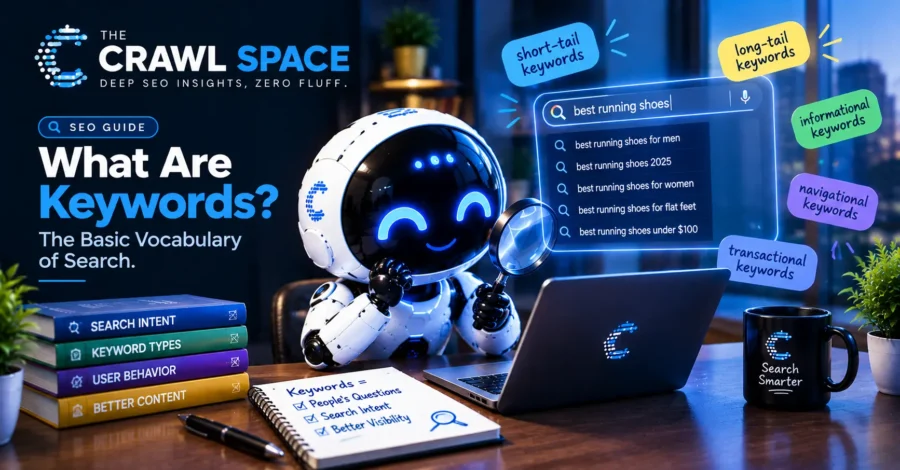
A keyword is any word or phrase a person types or speaks into a search engine — standing in for the actual question, problem, or need behind it, not just a string of text to match. This article is part of the What Is Keyword Research? guide and covers the basic vocabulary everything else in this cluster builds on.
Keywords Encode Intent, Not Just Words
The most important thing to understand about keywords, and the part beginners most often miss, is that a keyword isn’t just a literal string search engines match against page text. It’s a proxy for what the searcher actually wants. Someone typing “fix leaking faucet” isn’t looking for pages that happen to contain those three words — they’re looking for a solution to a specific, immediate problem, and a page needs to address that problem, not just repeat the phrase, to actually satisfy the search.
This matters because search engines have gotten much better at understanding meaning rather than matching exact text. Modern ranking systems can recognize that a page about “fixing a dripping tap” answers the same underlying need as “leaking faucet repair,” even without an exact phrase match.
The Two Main Ways Keywords Get Classified
Keywords get sorted along two independent dimensions, and mixing them up is a common source of confusion.
By length and specificity — a keyword can range from a broad, one- or two-word term to a longer, more specific phrase. This distinction shapes how much competition and search volume a term typically has.
→ Full guide: Long-Tail Keywords Explained
→ Full guide: Short-Tail Keywords Explained
By search intent — a keyword also falls into one of four intent categories (informational, navigational, commercial investigation, or transactional), based on what the searcher is actually trying to accomplish, independent of how long or short the phrase is. A short keyword and a long one can both be purely informational, or both be ready-to-buy transactional — length and intent are separate axes, not the same thing.
→ For the full breakdown: Search Intent in the main SEO guide
Other Useful Ways to Think About Keywords
Beyond length and intent, a few other distinctions come up often enough to be worth knowing, without needing a dedicated deep dive each:
- Branded vs. non-branded — searches that include a specific company or product name (“Nike running shoes”) versus generic searches for the same category (“running shoes”)
- Local keywords — searches with a geographic component, either explicit (“plumber in Austin”) or implied (“plumber near me”)
- Question-based keywords — phrased as a direct question (“how does compound interest work”), which tend to align closely with featured snippets and AI-generated answers
- Zero-volume keywords — terms that show little or no volume in keyword tools but still reflect a real, specific need, common in niche or B2B topics where tool data is sparse but genuine searches still happen
None of these require a separate research process — they’re just additional lenses for understanding a keyword you’ve already found, layered on top of length and intent.
The Outdated Idea Worth Retiring: Exact-Match Stuffing
Older SEO advice treated keywords as something to repeat as many times as possible, in as close to their exact form as possible, throughout a page. That approach is actively counterproductive today. Search engines evaluate meaning and topic coverage, not phrase frequency, and content that repeats a phrase unnaturally reads poorly for actual readers while providing no real ranking benefit. The useful question was never “how many times does this exact phrase appear” — it’s “does this page genuinely and thoroughly address what the person searching this term actually wants to know.”
Why This Vocabulary Matters
Every other article in this cluster — seed keywords, clustering, mapping, competitor research — assumes the basic vocabulary covered here. A keyword isn’t a target to hit as literally as possible; it’s a signal about intent, and everything from here forward in the keyword research process is about interpreting that signal accurately rather than chasing the phrase itself.
Frequently Asked Questions
Is a keyword always a single word?
No — despite the name, most keywords worth targeting are multi-word phrases. “Keyword” is industry terminology for any search query, not a literal restriction to one word.
Do I need to use a keyword’s exact phrasing in my content?
Not necessarily. Modern search engines understand close variations and related phrasing, so naturally covering a topic thoroughly matters more than repeating one exact phrase.
What’s the difference between a keyword and a topic?
A topic is the broader subject; keywords are the specific ways people actually search for pieces of that topic. A single topic usually maps to a cluster of related keywords rather than one exact phrase.
The Bottom Line
A keyword is a stand-in for a real question or need, not just text to match. Understanding that keywords split along two separate dimensions — length and intent — and layer with a few other useful distinctions (branded, local, question-based) gives the basic vocabulary the rest of this keyword research cluster builds on.