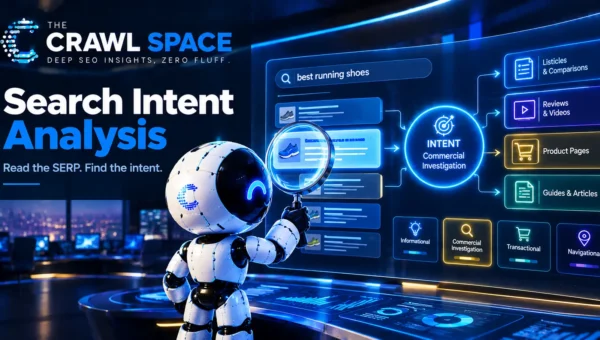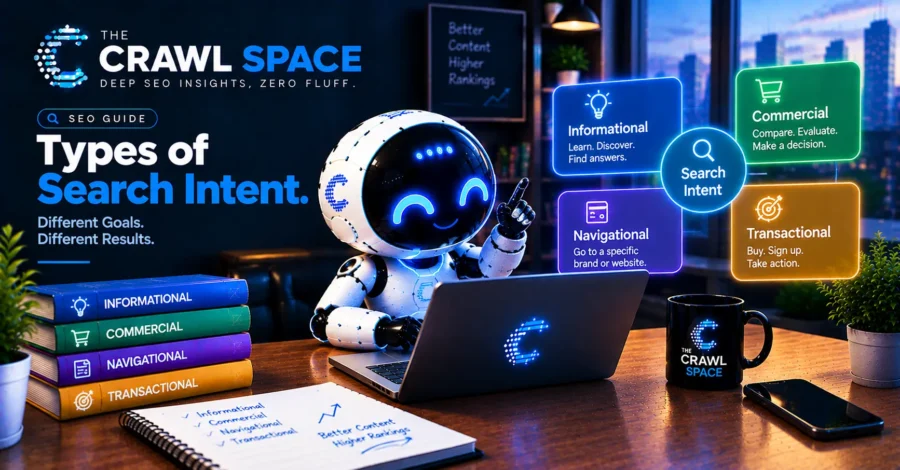
Search intent is classified two different ways in practice: the informational/navigational/commercial/transactional framework SEO practitioners use day to day, and Google’s own official classification — Know, Know Simple, Do, Website, and Visit-in-Person — used to train the human raters who evaluate search quality. This article is part of the What Is Search Intent? guide and goes deeper into both systems, and how they map onto each other, than the pillar’s introduction covers.
The SEO Framework, Briefly Recapped
The pillar already covers the four core practitioner-facing types — informational, navigational, commercial investigation, and transactional — plus two newer categories, local and generative, in full detail with examples.
What’s worth adding here is a second, distinct system: the one Google itself uses internally.
Google’s Own Classification: Know, Do, Website, Visit-in-Person
Google’s Search Quality Rater Guidelines — the official document used to train the human evaluators who assess search result quality — define user intent using a different, more granular vocabulary than the marketing-industry framework most SEO content uses.
- Know queries are where the user wants information or an answer to a question, without a specific site or action in mind. This maps closely to informational intent, but Google’s own guidelines split it further:
- Know Simple — the user wants one specific, quick fact, number, date, or answer, and expects it immediately rather than wanting to read through multiple sources. A search for a specific statistic or a direct factual question typically falls here.
- Know (broader) — the query is more open-ended, and different users searching the same term might genuinely want different depths or angles of information, without one single correct short answer.
This distinction matters practically: a Know Simple query is best served by a page structured to surface a direct, immediate answer near the top — the kind of content that tends to earn featured snippets. A broader Know query is better served by a genuinely comprehensive guide, since no single short answer would satisfy everyone searching that term.
Do queries are where the user has an end goal of accomplishing something — buying, downloading, or completing an action through a website or app. This maps closely to transactional intent, and Google’s guidelines note that even a query like “buy iPad” might actually reflect a Do intent still in the research phase (reading reviews before purchasing) rather than an immediate purchase — intent isn’t always as clean-cut as the surface wording suggests.
Website queries are where the user wants to navigate to a specific site or page, often because they don’t know or don’t want to type the exact URL. This maps directly to navigational intent.
Visit-in-Person queries are where the user wants to find a specific physical location or business — what the SEO industry generally calls local intent. Google’s own guidelines note that the expected proximity varies by business type: someone searching for a specific restaurant may be willing to travel further than someone searching for a nearby gas station or coffee shop, where immediate proximity matters much more.
How the Two Systems Map Onto Each Other
| SEO Industry Term | Google’s Official Term | Relationship |
|---|---|---|
| Informational | Know / Know Simple | Google’s version splits informational intent by how quick and direct the expected answer is |
| Navigational | Website | Close to a direct equivalent |
| Transactional | Do | Close to a direct equivalent, though Google’s definition explicitly includes users still researching before acting |
| Local | Visit-in-Person | Close to a direct equivalent |
| Commercial investigation | Not a distinct official category | Generally treated as a form of Know or Do depending on how close the user is to deciding |
| Generative | Not covered in the rater guidelines | A newer category tied to AI chat tools, outside the scope of traditional search rating |
Neither system is more “correct” than the other — the SEO industry framework is more practical for everyday content planning, while Google’s own classification reveals distinctions (particularly Know vs. Know Simple) that directly affect what content format actually satisfies a query.
Queries With Multiple Intents Are Explicitly Acknowledged
Google’s own guidelines directly address that a single query can carry more than one plausible intent at once, instructing raters to use judgment based on context rather than forcing every query into exactly one box. This isn’t just a practical simplification SEO content makes — it’s built into the official framework itself, reinforcing that treating every search as a single, clean intent category oversimplifies real search behavior.
Why the Know vs. Know Simple Distinction Matters Practically
Most SEO content treats all informational searches as one undifferentiated bucket, but the Know Simple distinction has real, actionable implications. A query expecting a Know Simple answer rewards content structured around a direct, concise, prominently placed answer — exactly the format that tends to win featured snippets and get pulled into AI-generated overviews. A broader Know query rewards depth and thoroughness instead, since a single short answer would leave most searchers unsatisfied. Misreading which of the two a query actually is — treating a Know Simple query like it needs a comprehensive guide, or a broad Know query like it needs a one-line answer — is a subtle but common content-format mismatch.
Common Mistakes
- Treating all informational queries identically, missing the Know vs. Know Simple distinction that should shape content format
- Assuming Google’s official terms and the SEO industry’s terms are perfectly interchangeable, when they overlap significantly but aren’t identical, particularly around commercial and generative intent
- Ignoring that Do queries can include research behavior, treating every transactional-looking query as a searcher ready to buy immediately
- Forcing every query into a single intent category, when both classification systems explicitly acknowledge that queries can carry more than one
Frequently Asked Questions
Is Google’s official classification more accurate than the SEO industry’s four-type framework?
Neither is strictly more accurate — they serve different purposes. The SEO framework is built for practical content planning; Google’s own classification reflects how the company trains its own human quality raters, and offers more granular distinctions in some areas (Know vs. Know Simple) while omitting others the SEO industry tracks (commercial investigation as its own category).
Where can I read Google’s official intent classification directly?
It’s covered in Google’s publicly available Search Quality Rater Guidelines document, specifically in the section on understanding user intent.
Does the Know Simple vs. Know distinction affect keyword research?
Yes — recognizing which type a target query is helps determine the right content format before writing anything, the same evaluation covered in How to Do Keyword Research when checking what’s already ranking for a term.
The Bottom Line
Search intent gets classified two complementary ways: the practical informational/navigational/commercial/transactional/local/generative framework most SEO content uses, and Google’s own official Know/Know Simple/Do/Website/Visit-in-Person system used to train its human quality raters. The two map onto each other closely but not perfectly, and Google’s own Know vs. Know Simple split in particular reveals a content-format distinction most SEO content overlooks entirely.