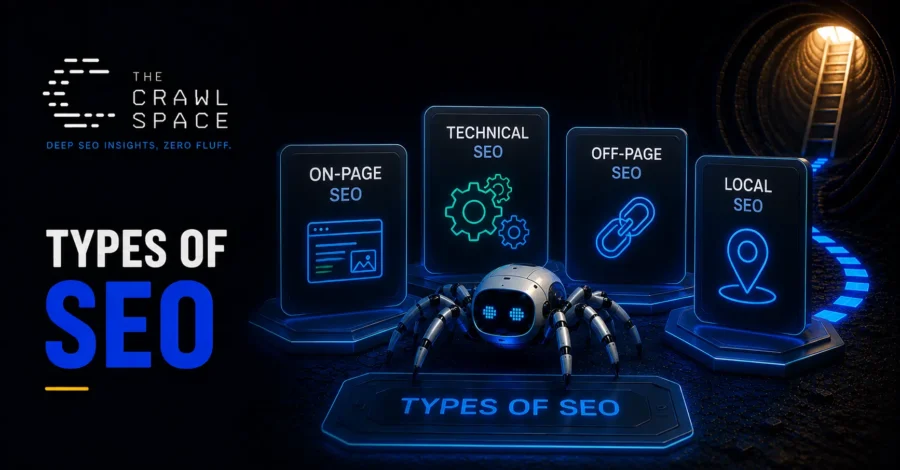
“Types of SEO” isn’t really one list — SEO branches along several separate dimensions at once: the technique being applied, the kind of business or site it’s for, the content format involved, and the platform being optimized for. This article is part of the What Is SEO? guide and expands on the types only briefly introduced there, organized so it’s clear which types actually apply to a given site rather than presenting a long, undifferentiated list.
First, the Three Techniques Everything Else Builds On
Every type of SEO below still relies on the same three underlying techniques covered in the main guide: on-page, technical, and off-page SEO. A local business, an online store, and a B2B SaaS company all need these three — what changes is which specialized layer gets added on top.
→ For the full breakdown: the three pillars section of the main guide
Types by Business Model
These are the types most directly tied to what a business actually sells, and the ones most sites need to think about first.
- Local SEO — for businesses serving a specific geographic area: restaurants, contractors, clinics, law firms. Centers on a Google Business Profile, consistent name/address/phone data, and local reviews, since the goal is showing up in map-based and “near me” results.
- E-commerce SEO — for online stores managing product and category pages at scale, often facing duplicate-content challenges from filters and variants, and relying on review schema to earn visible star ratings in results.
- B2B and SaaS SEO — for businesses selling to other companies rather than individual consumers. The buying cycle is longer, often involving multiple stakeholders researching independently, so content typically needs to serve the entire journey — educational content for early research, comparison content for active evaluation, and bottom-funnel pages like feature comparisons or alternatives pages for buyers close to a decision. Keywords tend to be longer, more specific, and lower-volume, but each conversion is worth substantially more than a typical consumer purchase.
- Enterprise SEO — for large organizations managing SEO across many pages, subdomains, or brands at once, where the core challenge shifts toward process, governance, and technical scale (crawl budget, site architecture, and coordinating changes across many stakeholders) more than any single new technique.
Types by Content Format
These apply based on what kind of content a site actually produces, layered on top of the core techniques rather than replacing them.
- Video and YouTube SEO — optimizing titles, descriptions, and transcripts so video content is findable both within YouTube’s own search and in regular Google results, since YouTube functions as a search engine in its own right for a large share of its traffic.
- Image SEO — descriptive file names, alt text, and appropriate compression, which help both accessibility and a page’s eligibility to appear in image-specific search results.
- Voice SEO — optimizing for spoken, conversational queries rather than typed ones, which tend to be longer and more naturally phrased (“what’s the best pizza place near me that’s open now” instead of “pizza near me open”). Voice search has grown into genuinely mainstream behavior across smart speakers and phone assistants, though exactly how much distinct optimization it requires beyond strong conversational content and structured, direct answers remains debated within the industry.
Types by Search Platform
- Google SEO — what most general SEO guidance, including this one, is built around, since Google handles the large majority of global search volume.
- Bing SEO — a distinct discipline worth real consideration for B2B audiences and Microsoft-ecosystem-heavy users, since Bing powers Microsoft Edge, Windows Search, and Copilot. Bing’s algorithm weighs some signals differently than Google’s, including giving relatively more weight to exact-match keyword usage and domain age.
- App Store Optimization (ASO) — a genuinely separate discipline from web SEO, focused on ranking a mobile app within the Apple App Store or Google Play Store’s own search systems, which work on different signals entirely (install rates, ratings, keyword fields specific to each store) than traditional web search.
Search also increasingly happens inside individual platforms — Amazon’s own product search, YouTube’s search bar, and social platforms with search functionality of their own. These function more like adjacent, platform-specific optimization challenges than fully distinct “types of SEO” in the traditional sense, but they’re worth being aware of if a business depends heavily on visibility within one of them specifically.
Which Types Actually Apply to You
| Business Type | Core Techniques (Always) | Add These Types |
|---|---|---|
| Local service business | On-page, technical, off-page | Local SEO first; content and AI SEO layered in over time |
| Online store | On-page, technical, off-page | E-commerce SEO from day one |
| B2B / SaaS company | On-page, technical, off-page | B2B/SaaS-specific content strategy; international SEO if selling globally |
| Content publisher or blog | On-page, technical, off-page | Image and/or video SEO depending on content mix |
| Mobile app business | On-page, technical, off-page | ASO, typically alongside standard web SEO for a companion site |
The Most Common Mistake: Chasing Exotic Types Before the Fundamentals
It’s tempting to treat an expanding list of SEO “types” as a checklist to work through. In practice, skipping the technical foundation to chase a more specialized type — optimizing for voice search before the site is even reliably crawlable, for instance — rarely pays off. Every specialized type covered here still depends on the core three techniques working properly first; none of them substitute for that foundation.
Frequently Asked Questions
Do I need to specialize in every type of SEO that applies to my business?
Not necessarily all at once. Prioritizing the core techniques plus the one or two business-model types that most directly apply (local, e-commerce, or B2B/SaaS) covers most of the practical value before more specialized types like voice or platform-specific optimization become worth the effort.
Is Bing SEO worth doing separately from Google SEO?
For most consumer-facing sites, optimizing well for Google covers the large majority of search traffic and naturally helps Bing performance too, since the two share many of the same underlying signals. It’s worth dedicated attention specifically for B2B audiences or Microsoft-ecosystem-heavy markets.
Is ASO the same thing as SEO?
They share the same underlying goal — visibility in a search system — but the actual ranking signals are different, since app stores weigh factors like install and uninstall rates, ratings, and store-specific keyword fields rather than backlinks or traditional web content signals.
The Bottom Line
SEO isn’t a single expanding checklist — it splits across technique, business model, content format, and platform, and most sites only need a focused combination of a few of these rather than all of them at once. Getting the core three techniques solid first is what makes every more specialized type actually pay off.