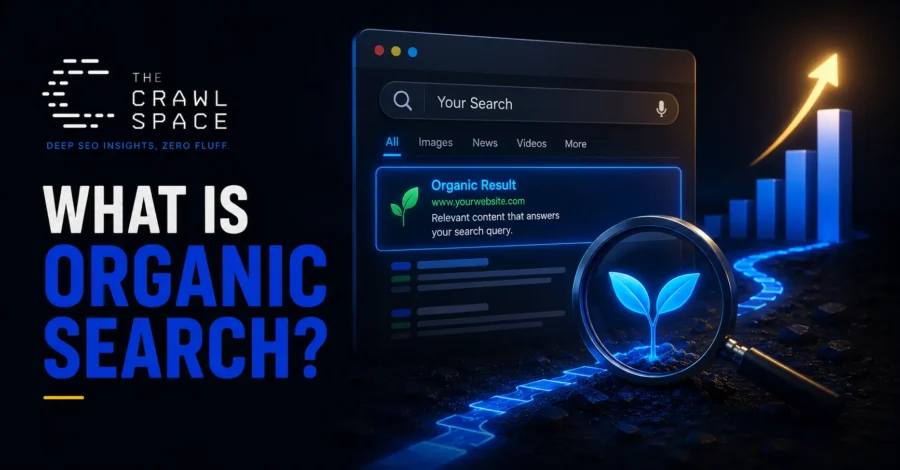
Organic search refers to the unpaid, algorithm-ranked listings on a search engine results page, and the traffic that comes from people clicking those listings rather than an ad. This article is part of the What Is SEO? guide and expands on the organic-vs-paid distinction introduced there.
Why It’s Called “Organic”
The term borrows the same sense “organic” has in food labeling — grown naturally, without artificial input. A page earns its spot in organic search results through relevance and quality as judged by the search engine’s ranking algorithm, not by paying for placement. Nobody bought that position; the algorithm decided it belonged there.
This is the direct counterpart to paid search: the “Sponsored” listings that appear above or alongside organic results, which someone bid money to have shown for that specific query.
Organic Search vs. Paid Search
| Organic Search | Paid Search | |
|---|---|---|
| Cost | No cost per click or placement | Pay per click or impression |
| How placement is earned | SEO — relevance, quality, and authority as judged by the algorithm | Bidding on keywords through an ad platform |
| Speed | Slow to build, often months | Immediate once the campaign launches |
| Duration of results | Persists after the work is done, though it can erode over time | Stops the moment spending stops |
| Labeled as | Regular, unmarked listings | “Sponsored” or “Ad” |
Neither replaces the other. Paid search delivers speed; organic search compounds. A page that ranks organically for a valuable term keeps earning clicks indefinitely without an ongoing bill, while a paused ad campaign stops generating traffic the same day.
→ For the broader SEO-vs-SEM distinction this fits into, see the main SEO guide.
Organic Search vs. Other Traffic Sources
Analytics tools typically classify visitors into channels, and organic search is only one of several:
- Organic search — arrived via an unpaid search engine listing
- Paid search — arrived via a search ad
- Direct traffic — typed the URL directly or used a bookmark
- Referral traffic — arrived via a link from another website
- Social traffic — arrived via a link on a social platform
Organic search is usually the largest single channel for most content-driven sites, though the exact split varies by industry, site type, and analytics methodology — one commonly cited estimate puts organic search at roughly half of all web traffic, with paid search well behind it, though figures like this shift with the source and time period, and should be treated as a general pattern rather than a precise, universal number.
How Organic Search Gets Measured
Organic performance is typically tracked through a handful of core metrics: organic traffic (visitors arriving via unpaid search listings), organic click-through rate (the percentage of people who click a listing when it’s shown), and ranking position (where a page lands for a given search term). Google Search Console reports all three directly for a site’s own pages, filtered specifically to organic results.
The AI Search Wrinkle
A newer complication: as AI-generated overviews and conversational answer tools handle more searches directly on the results page — sometimes without the person clicking through to any website — the traditional definition of “organic search traffic” gets harder to apply cleanly. Some of that activity still counts as organic in analytics tools; some of it results in zero clicks at all, and some traffic arriving from AI chat tools doesn’t always carry the referral data that would let analytics correctly attribute it as organic search in the first place. This is a genuinely unsettled measurement problem across the industry right now, not a solved one, and it’s part of why AI citation (covered in the AI SEO, GEO, and AEO guide) is increasingly discussed alongside, rather than instead of, traditional organic ranking.
Why Organic Search Matters
Organic search tends to attract high-intent visitors — people actively searching for something related to what a page offers, rather than being interrupted by an ad. That intent match, combined with the fact that many people trust unpaid listings more than sponsored ones, is a large part of why organic search consistently converts well relative to other channels, and why it remains the primary target of SEO work described throughout this guide.
Frequently Asked Questions
Is organic search traffic really free?
There’s no cost per click or per placement the way there is with paid search, but it isn’t free in the broader sense — it requires ongoing investment in content, technical work, and link building to earn and maintain.
Can a page show up in both organic and paid results for the same search?
Yes. A business can run a paid ad for a term while also ranking organically for it — the two aren’t mutually exclusive, and appearing in both can increase total visibility for that search.
Does organic search traffic ever decline on its own?
Yes. Rankings aren’t permanent — competitors publish new content, algorithms update, and a page that isn’t maintained can lose position over time even without anything being done wrong.
The Bottom Line
Organic search is the unpaid, algorithm-earned side of a search results page — the listings SEO work is aimed at improving, as distinct from paid ads and from other traffic channels like direct or referral visits. It remains the highest-intent, most durable traffic source for most sites, even as AI-generated answers complicate exactly how that traffic gets counted and attributed.