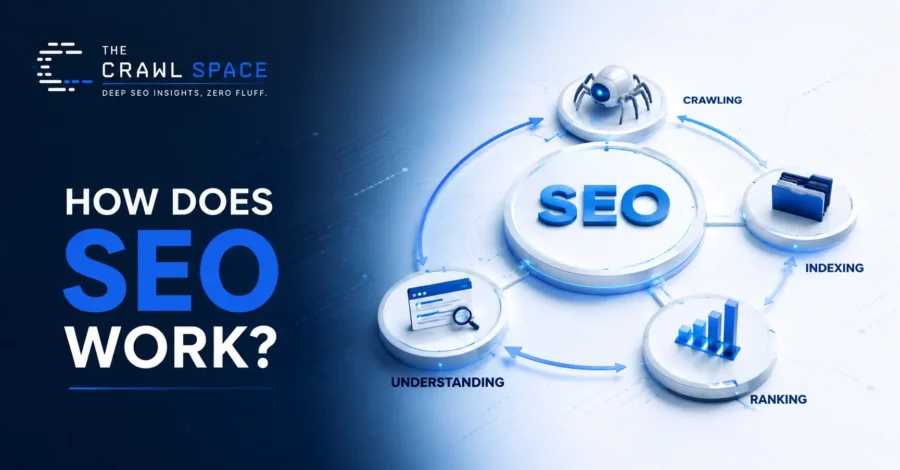
SEO works by helping search engines discover a page, understand what it’s about, and judge it trustworthy and useful enough to show for a given search — a process that runs on three back-to-back stages: crawling, indexing, and ranking. This article is part of the What Is SEO? guide and goes deeper into the actual mechanics behind that process.
Picture the Mechanism, Not Just the Outcome
In the pillar guide, SEO gets compared to a bakery trying to be visible on a busy street instead of hidden in a warehouse. That analogy explains why SEO matters. This article explains the machinery behind it — how Google actually finds the bakery, figures out what it sells, decides whether it’s any good, and updates that judgment over time as the street changes.
That machinery runs in three stages, followed by an ongoing feedback loop that never really stops.
The Three Stages, in Brief
Crawling is how automated bots (Google’s is Googlebot) follow links and sitemaps to discover a page exists at all. Indexing is where a crawled page’s content gets analyzed, evaluated for quality and duplication, and stored in Google’s searchable database. Ranking is where, for any given search, that indexed content gets ordered using hundreds of signals — relevance, trustworthiness, authority, and how well it satisfies the intent behind the search.
For the full technical breakdown of how each of those three stages actually works — including why modern ranking increasingly relies on machine learning rather than fixed formulas — see the dedicated guide:
→ Full guide: How Do Search Engines Work? The Technology Behind Every Search
What matters for this article isn’t re-explaining that mechanism — it’s what an SEO practitioner actually does in response to it, and why that response has to keep repeating.
The Part Most Explanations Leave Out: SEO Is a Loop, Not a Sequence
Crawling, indexing, and ranking aren’t a one-time gate a page passes through. Google recrawls and re-evaluates pages continuously, and rankings shift as competitors publish new content, as your own site changes, and as Google’s algorithms update. In practice, SEO work follows an ongoing cycle:
- Research — understand what your audience searches for and why.
- Optimize and publish — build and structure content that satisfies that intent, technically and editorially.
- Get crawled, indexed, and ranked — the mechanism described above runs against what you published.
- Measure — track how it actually performed.
- Refine — adjust based on real results, and start again.
This is why a page that ranked well a year ago can quietly lose position without anything on it changing — the competitive and algorithmic environment around it kept moving.
What Actually Moves Each Stage
Each stage of the mechanism above is influenced by a different kind of work:
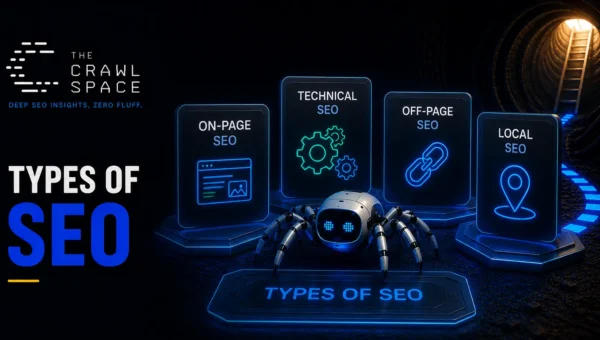
- Crawling and indexing are mostly a technical SEO concern — site structure, sitemaps, and making sure nothing accidentally blocks access.
- Ranking relevance is mostly an on-page SEO concern — content quality, structure, and how directly it satisfies search intent.
- Ranking authority and trust** is mostly an off-page SEO concern — backlinks and reputation built outside your own site.
For the full breakdown of all three, see the three pillars section of the main SEO guide.
A Common Misunderstanding
A lot of beginners picture SEO as something you configure once — add some keywords, submit a sitemap, done. The mechanism above shows why that’s not how it works: ranking is a continuously re-run evaluation, not a one-time approval. A page that stops getting maintained, linked to, or updated will typically lose ground over time, even without anyone doing anything wrong — the rest of the web just keeps moving while it stands still.
Frequently Asked Questions
Does SEO work the same way for every search engine?
The three-stage mechanism (crawl, index, rank) is broadly shared across major search engines, though the specific signals and their weighting differ. Most SEO guidance, including this one, focuses on Google, since it handles the large majority of global search traffic.
How quickly does a new page get crawled and ranked?
It varies widely based on the site’s overall crawl activity and authority — anywhere from hours to weeks for initial crawling, and ranking position can keep shifting for months afterward as the page accumulates signals like backlinks and user engagement data.
Can a page be indexed but not ranked well?
Yes — that’s actually the normal state for most pages. Being indexed just means Google has stored and can retrieve the page; ranking well for a specific, competitive search is a separate bar the page may or may not clear.
The Bottom Line
SEO works through a three-stage mechanism — crawling, indexing, and ranking — wrapped inside an ongoing research-optimize-measure-refine cycle that never fully stops. Understanding the mechanism matters because it explains why the practical work covered in the main SEO guide — technical health, strong content, and earned authority — actually moves the needle, instead of feeling like a checklist followed on faith.