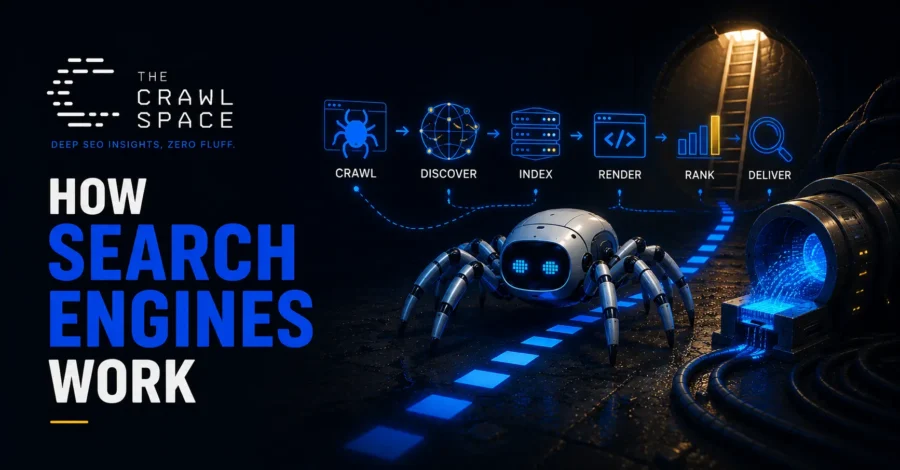
A search engine works by continuously discovering content across the web, organizing it into a searchable index, and then, for each query someone types, retrieving and ranking the most relevant matches from that index in a fraction of a second. This article is part of the What Is SEO? guide and explains the underlying technology — for how SEO practitioners actually work within this system day to day, see How Does SEO Work?.
The Problem Search Engines Actually Solve
There are trillions of individual pages on the web, and no person could browse even a meaningful fraction of them by hand. A search engine’s entire job is to stand between that overwhelming volume of content and a person who wants one specific answer, right now — functioning something like a reference desk for the entire internet, one that has already read everything and can point you to the right shelf instantly.
Doing that requires three ongoing jobs, running continuously and largely out of sight: finding content, organizing it, and matching it to what people ask for.
Job 1: Discovery (Crawling)
Crawling is how a search engine finds content that exists on the web in the first place, using automated programs called crawlers or bots that follow links from page to page. Google’s crawler is called Googlebot. It doesn’t browse the web the way a person does — it starts from known pages, reads the links on them, follows those links to new pages, reads the links on *those*, and keeps going, at a scale of billions of pages.
Site owners can also submit an XML sitemap — essentially a direct list of URLs — to help a crawler find pages faster than it would by following links alone. Files like robots.txt let a site owner tell crawlers which areas to skip. Because discovery depends entirely on links and sitemaps, a page with no path leading to it can go completely unnoticed, not because anything is wrong with it, but because nothing ever pointed the crawler there.
→ Full guide: What Is Crawling? Crawl Budget, robots.txt, and Sitemaps Explained
Job 2: Organization (Indexing)
Indexing is where a search engine analyzes what it crawled and stores it in a massive, searchable database called the index. This isn’t just filing pages away — during this stage, the engine reads the text, images, and other content on a page, evaluates its quality, checks whether it duplicates something already indexed, and decides whether it’s worth keeping in the index at all. Google has described this filtering step as “index selection” — not every crawled page makes the cut.
The index itself functions like a massive, constantly updated card catalog for the entire web, organized so that when a query comes in, the engine doesn’t have to search the live internet in real time — it searches its own pre-built record of it, which is what makes results return in a fraction of a second.
→ Full guide: What Is Indexing? Index Coverage, noindex, and Canonical Tags Explained
Job 3: Matching and Ordering (Retrieval and Ranking)
When someone runs a search, the engine first retrieves every indexed page that could plausibly be relevant, then ranks those candidates in order using an algorithm that weighs a large number of signals. This happens in two distinct steps: retrieval narrows billions of indexed pages down to a manageable set of candidates that relate to the query at all; ranking then decides the actual order those candidates appear in.
The ranking step has changed significantly over time. Early search ranking relied on engineers writing explicit formulas — combining signals like link authority, keyword match, and freshness into a fixed weighted score. Modern ranking increasingly relies on machine learning models trained on massive sets of past queries and human-rated results, learning what tends to make a result relevant rather than following a formula anyone wrote by hand directly. This is part of why search results can handle vague or conversational queries reasonably well — the system has learned patterns of relevance rather than matching literal keywords.
→ Full guide: What Is Ranking? How Google Actually Orders Results
It’s Not Just Google
Google handles the large majority of global search volume, which is why most SEO guidance — including this site’s — centers on it. But it isn’t the only search engine running this same basic process. Microsoft’s Bing operates on similar crawl-index-rank principles, and search engines like Baidu (dominant in China), Yandex (widely used in Russia), and Naver (South Korea) serve their own regions with their own ranking systems, which don’t always weigh the same signals the same way. Privacy-focused engines like DuckDuckGo layer their own approach on top of underlying search infrastructure rather than building an entirely separate index from scratch.
More recently, AI-powered answer tools — Google’s AI Overviews and AI Mode, and standalone tools like ChatGPT’s search feature or Perplexity — have added a layer on top of this same basic retrieval concept: finding relevant content, then generating a direct answer from it instead of just listing links. The underlying retrieval mechanics are related, but citation in an AI-generated answer isn’t governed by the same ranking process as a traditional results list.
Why This Matters Beyond Curiosity
Understanding this system isn’t just background trivia — it explains why specific SEO practices exist. A page has to be discoverable (crawling) before it can be stored (indexing), and it has to be stored before it can ever be ranked and served. Every piece of practical SEO advice about sitemaps, internal links, site speed, or content quality is ultimately aimed at one of these three jobs. The SEO process guide covers what to actually do in response to this system; this article covers why that system works the way it does.
Frequently Asked Questions
Do all search engines use the exact same ranking factors?
No. The general crawl-index-rank structure is shared, but the specific signals and how heavily each is weighted differ by search engine and change over time as engines update their systems.
How does a search engine handle a brand-new page it’s never seen?
It has to be discovered through crawling first — either by following a link to it or reading it from a submitted sitemap — before anything else in the process can happen.
Is AI search a replacement for traditional search engines?
Not currently for most use cases — AI-generated answers and traditional ranked results tend to coexist on the same results page, and many searches still lead to a traditional link rather than a generated summary.
The Bottom Line
A search engine is fundamentally a discovery, organization, and matching system — crawling to find content, indexing to organize and evaluate it, and retrieval-plus-ranking to match it to what someone actually asked for, increasingly through machine learning rather than fixed formulas. Everything in SEO exists as a response to this underlying system. The main SEO guide covers what SEO is as a discipline; how SEO actually works covers the ongoing practitioner process built on top of the technology described here.